
The Evolution of the Digital Saw Fence | Kangastop CNC
Have you ever stood on the factory floor and watched an operator spend more time walking up and down a measuring rail than actually cutting material? It is a massive, hidden drain on your profitability. A digital saw fence, or automated measuring system, replaces that old manual tape measure and bump stop with a computer-controlled unit that positions your materials instantly and accurately.
What were the early challenges of manual measuring?
Before automation, the standard method for cutting materials required operators to physically measure, mark, and align every single piece. The operator would have to set the material on the conveyor, trim the end, walk down the rail to adjust the stop, walk back to the saw, make the cut, and then repeat the entire process for the next length.
The limitations of the traditional table saw rip fence and manual stops
While a traditional table saw rip fence or manual bump stop was a step up from using a hand-held tape measure, it remained incredibly labour-intensive and prone to human error. If an operator misread a measurement or forgot to lock the fence down securely, an entire batch of material could be cut slightly too long or short. This created a nightmare for assembling staff who then had to manually trim sections to make them fit, wasting both raw material and valuable time.
How did the transition to digital readouts improve precision?
The first step toward modern automation was the introduction of the digital readout. Instead of relying on a printed ruler or measuring tape attached to the conveyor, operators could reference a digital screen that displayed the exact position of the stop. While this improved accuracy and reduced reading errors, it did not solve the fundamental problem of physical labour.
The operator still had to manually slide the stop and lock it into position. Although a digital readout was a helpful precision tool, it was not a true CNC saw fence because it lacked the motor and computer required to drive the stop automatically.
What is the impact of a CNC-controlled fence on factory automation?
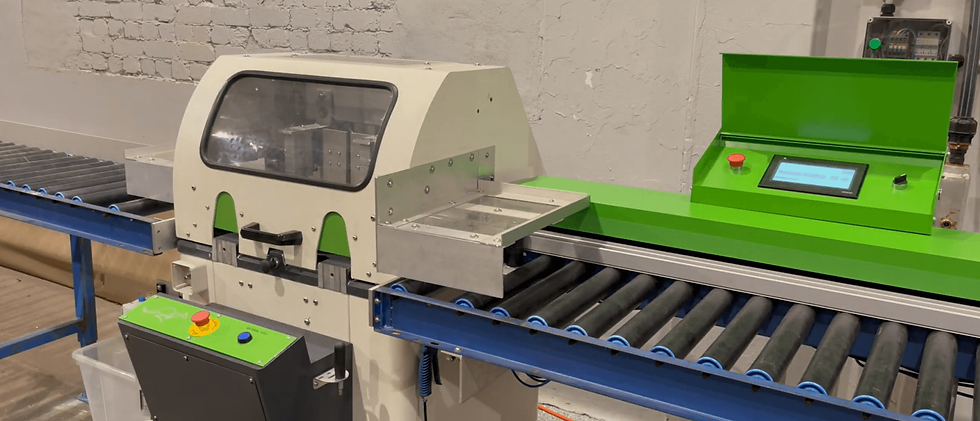
A true Computer Numerical Control (CNC) fence takes the manual labour entirely out of the measuring process. The technology we use has been around for many years and is basically the same reliable system used in computer-operated milling machines. You simply enter the required cut length in millimetres into a touchscreen, and the machine automatically moves to the exact position.
Integrating digital encoders and servos
To make this happen, the system relies on a servo-driven encoder. As the motor turns, the encoder provides constant feedback to the computer, confirming exactly where the stop is located. We combine this with steel-reinforced drive belts and custom extruded aluminium pulleys. This ensures the PLC controlled measuring system is robust enough to handle the repetitive, heavy-duty demands of a bustling factory without losing tension or accuracy.
The advantages of computer numerical control in woodworking and metal shops
Whether you are using an automated cutting system for timber trusses or aluminium extrusions, CNC technology provides absolute consistency. An operator enters the data via a Human-Machine Interface (HMI)—which is simply a heavy-duty, dust-resistant touchscreen. Because the computer calculates the exact distance to move based on fixed-pitch belts, human measuring errors are completely eliminated.
Why are industrial-grade Omron PLCs the heart of modern accuracy?
The "brain" behind any reliable digital stop is its Programmable Logic Controller (PLC). At Kangastop, we use premium, industrial-grade PLCs and HMI touchscreens sourced from our trusted Japanese supplier, Omron. The PLC is responsible for sending rapid, precise electrical pulses to the servo motor, telling it exactly how many times to rotate to reach the target length.
How Omron PLC accuracy ensures sub-millimetre precision
Omron PLC accuracy is the reason our machines can consistently deliver repeatable precision of ±0.1 mm. By using these high-end, industrial-quality components rather than cheap consumer electronics, we ensure that every single cut is identical to the last. This level of sub-millimetre precision means your assembly team will never have to waste time trimming badly cut parts again.
Ensuring reliability in demanding Australian manufacturing environments
We pride ourselves on offering reliable, Australian-made machinery. By building our systems locally, we ensure our customers have ready access to spare parts and direct, local phone support without ever having to wait weeks for overseas shipping. This local manufacturing advantage is exactly why we can confidently back our machines with an industry-leading 10-year warranty covering both parts and labour.
Kangastop's automated solutions for sawstops and punch systems
We designed our entry-level Kangastop Tradesman to be an affordable, bolt-on measuring stop. However, many customers told us they were tired of buying a stop from one supplier and a saw from another, only to get caught in the middle when the two companies blamed each other for a breakdown. That is why we offer fully integrated, "turn-key" solutions. We take responsibility for both the saw and the measuring system, so our customers only ever have to make one phone call for support.
What are the future trends in automated measuring solutions?
The future of the digital saw fence lies in complete factory integration and data management. We are currently testing remote order entry programs that allow your purchasing or drafting departments to create cut lists on a Windows PC. These lists are run through an integrated optimisation program to calculate the most efficient cutting sequence, minimising raw material waste.
The operator then simply loads the data into the machine via a USB stick. The machine tells the operator what to load, pushes the material, and can even automatically print a low-tack barcode label for each cut piece. This level of automation bridges the gap between the front office and the factory floor, ensuring maximum profitability.
Frequently Asked Questions
What is a digital saw fence?
A digital saw fence is a computer-controlled measuring stop that replaces manual tape measures. You enter your required cut length into a touchscreen, and a motorised carriage automatically moves the stop to the exact position, accurate to within ±0.1 mm.
How does a CNC saw fence improve productivity?
By eliminating the need for an operator to walk up and down a rail to manually measure and lock down a stop, a CNC fence reduces the time required to process materials by a minimum of 50%. This effectively doubles your saw's daily output.
What does PLC stand for in automated measuring?
PLC stands for Programmable Logic Controller. It is the industrial-grade computer "brain" of the machine. It reads the length entered on the touchscreen and sends precise electrical pulses to a servo motor to move the stop to the correct location.
Can a digital stop be fitted to my existing saw?
Yes. Entry-level systems like the Kangastop Tradesman are designed to integrate easily with your existing drop saws, drill presses, or punch systems. We even offer a steel conveyor mounting kit to attach the unit to your existing tables.


Comments