
Automated Table Saw Technology: Are You Falling Behind?

What is Automated Table Saw Technology?
If you’re still relying on a manual rip fence and a steady hand, you’re essentially trying to win a race while tied to an anchor. The reality is that the big players in manufacturing aren’t smarter than the small shops - they just have tools that don't get tired or distracted.
Automated table saw technology is the integration of computer-controlled measuring systems into your cutting process to eliminate manual measuring and operator guesswork. The primary benefit of this technology is that it reduces cutting time by over 50% compared to manual systems, and it provides a rapid payback period of under 12 months for small businesses.
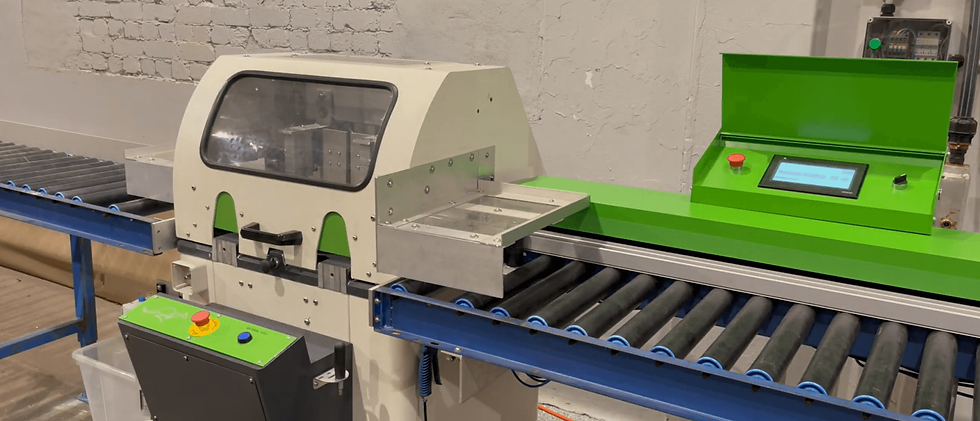
Instead of an operator walking up and down a conveyor with a tape measure, a digital table saw stop automatically moves to the exact required length. You simply enter the measurement into a touchscreen, and the machine positions the material for you.
Are Traditional Table Saws Holding Your Business Back?
Traditional manual table saws hold manufacturing businesses back because they rely on slow, physical measurement adjustments that inherently waste both raw materials and labour hours.
The Competitive Gap with Larger Manufacturers
Large manufacturing plants process high volumes of material quickly because they rely on CNC panel cutting and automated feeds. If your business is still using manual tape measures and clamps, you cannot match their daily output. Small to medium manufacturers fall behind the curve when their highly paid operators spend more time adjusting fences than they do cutting material.
Manual Measuring Limitations in Modern Production
Manual measuring introduces operator fatigue and human error into your production line. When operators are manually adjusting an automatic rip fence or stop throughout an 8-hour shift, mistakes happen, and timber or aluminium is cut slightly too long or too short.
This means your assembling staff then have to trim those sections manually so they fit together, and this process wastes valuable production time. By replacing manual steps with programmable saw positioning, you remove the physical toll of the job and ensure every single cut is exactly right the first time.
How Automated Table Saws Work: Key Components
Automated table saws work by using a computer program to calculate the exact distance a stop needs to move, and it sends pulses to a motor to drive the stop to that specific point. This is the exact same reliable technology that is used in computer-operated milling machines.
Digital Length Stops and Servo Positioning
The core of the system relies on an industrial-grade Programmable Logic Controller (PLC) to process the measurements. The PLC sends a calculated number of pulses to a servo motor, and the motor rotates a specific number of times. This motor is connected to a steel-reinforced belt on a fixed pitch gear, and this drives the digital stop down the aluminium extrusion to the correct measurement.
Programmable Controls for Repeat Accuracy
Operators interact with the machine through a Human-Machine Interface (HMI), which is a dust-resistant touchscreen. The operator enters the required length on the HMI, and the system positions the stop with a repeatable accuracy of ±0.1 millimetres. Once the machine is calibrated to the saw blade, the operator simply types in the numbers, and the machine guarantees precision table saw automation every single time.
Staying Competitive: Small Australian Manufacturers vs Big Players
Small Australian manufacturers stay competitive against larger overseas players by retrofitting automated technology to their existing machinery to instantly double their productivity without exorbitant upfront costs.
Timber Processing and Cabinetry Applications
Automated cutting solutions are highly versatile and serve a wide variety of industries that require repetitive, accurate measuring. Common applications include:
Timber truss manufacturers cutting structural framing.
Cabinetry and wardrobe manufacturers requiring precise panel cuts.
Aluminium window and shower screen manufacturers processing extrusions.
Sign writing and industrial packing businesses looking to speed up workflow.
Kangastop's Retrofit Solutions for Table Saws
You do not always need to buy a completely new saw to automate your factory. We provide digital measuring stops that integrate directly onto your existing steel framed conveyors using a simple mounting kit.

If you are looking for a completely new setup, we strongly advocate for "turn key" integrated solutions where we supply both the saw and the measuring device. This means you only ever have to make one phone call for support, and you avoid the situation where the saw manufacturer blames the stop manufacturer for an issue.
Because Kangastop units are Australian made, you get the practical operational advantage of local support. You have ready access to spare parts without waiting on overseas shipping, and we back our locally built industrial components with a 10-year warranty covering both parts and labour.
Table: Manual vs Automated Table Saw Productivity
Production Metric | Manual Table Saw | Automated Table Saw (e.g., Kangastop Plus) |
Measurement Process | Operator walks the line to adjust the stop. | Operator enters dimension into HMI; stop positions automatically. |
Labour Efficiency | Requires 8 hours for standard high-volume jobs. | Reclaims 4 hours of an operator's 8-hour day. |
Accuracy & Error | Prone to human error causing rework at assembly. | ±0.1 mm repeatable accuracy, zero assembly rework. |
Material Waste | High reliance on operator judgement for offcuts. | Achieves a 12–15% reduction in raw material wastage. |
Essential Benefits Driving Industry Adoption
The core benefits driving small and medium businesses to adopt this technology are a massive reduction in raw material waste and the ability to reclaim 4 hours of an operator's 8-hour day.
Zero Operator Error and Waste Reduction
Upgrading to an automated system completely eliminates operator measuring errors. By utilising an integrated optimisation program, the software calculates the most efficient cutting sequence for your entered lengths. Customers using this software routinely achieve a 12–15% reduction in raw material wastage, dropping their waste generation from 12 bales down to 8 bales a month.
Safety Improvements and Speed Gains
Automation dramatically improves factory floor safety while increasing speed. The operator loads the material, and the pusher unit handles the heavy lifting, safely feeding the material towards the blade. By controlling the measuring and the material feed via the HMI, the operator's hands are kept away from the cutting zone, and the physical fatigue of the shift is eliminated.
Frequently Asked Questions About Automated Table Saws
What is the payback period for an automated measuring system?
With an entry-level unit starting from $5,990 for a 3.0m unit, the payback period for a standard small manufacturing business is generally less than 12 months, simply due to the immediate 50% reduction in labour processing time.
Can I fit an automated stop to my existing saw?
Yes. We have produced a steel conveyor mounting kit that allows our measuring systems to be easily mounted to the majority of steel-framed conveyors by simply drilling a few holes.
What happens if the machine breaks down?
Because we use industrial-grade components from suppliers like Omron and Festo, breakdowns are rare. However, our machines are Australian made, meaning you have immediate local phone support, fast access to spare parts, and the protection of a 10-year warranty on parts and labour.
Don't Get Left Behind – Automate Your Table Saw Today
If you are tired of losing raw material to operator error and want to double your cutting productivity, it is time to upgrade your measuring process. We build reliable, practical machinery that delivers real bottom-line results for Australian manufacturers.
We invite you to see the machinery in action for yourself. Contact Michael or Doug to arrange a factory visit at our Riverstone facility, schedule a Zoom demonstration, or simply have a direct phone call to discuss your specific production needs.


Comments