
Sawstop Digital Readouts Explained: Millimetre Precision

You don't need a degree in software engineering to understand why your cuts are inconsistent - you just need to look at the interface between the human and the machine.
By moving from eye-balling a tape measure to entering a digital number, you’re bringing industrial-grade accuracy to your workshop for a fraction of the cost of an overseas machine.
What is a Sawstop Digital Readout?
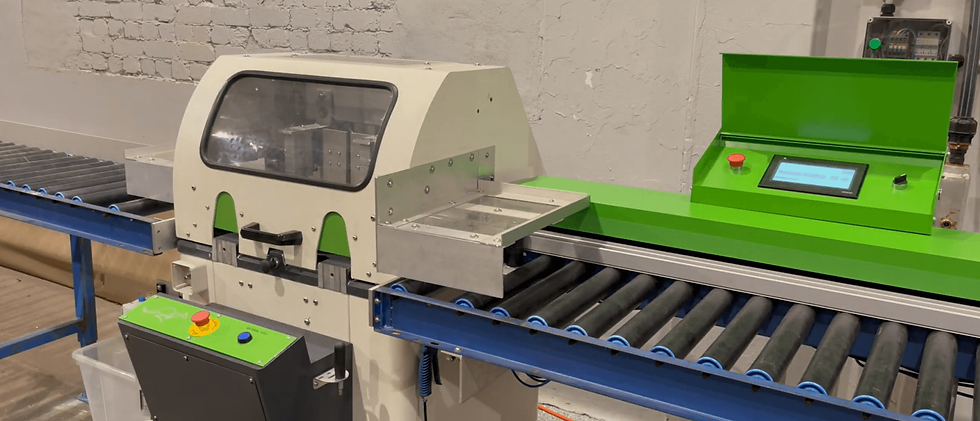
A sawstop digital readout is the visual interface and control unit of a computer-controlled measuring machine. Instead of walking up and down a cutting bench to adjust a mechanical stop by hand, the operator uses a touch screen known as a Human-Machine Interface (HMI) to input their required measurements. The machine then uses an industrial-grade computer, called a Programmable Logic Controller (PLC), to move the stop into the correct position.
This setup completely removes the guesswork from factory operations and eliminates the need for manual measuring. Once the operator enters the length in millimetres, the stop moves accurately into place, and the operator simply feeds the material against it for a perfect cut. The entry-level machines operate as a bump stop where the material is pushed against the fence, and more advanced models can actively push the material through the saw for you.
How Do Servo-Driven Encoders Calculate Precise Movement?
To understand how these machines achieve repeatable accuracy of ±0.1 mm, you have to look at the motor and control system. The technology we use has been around for many years, and it is basically the same technology that is used in computer-operated milling machines.
Encoders: Tracking Every Millimetre
The secret to absolute precision is the servo encoder readout. An encoder is a built-in sensor that constantly tracks the exact physical position of the motor shaft. As the motor turns, the encoder reads its position and sends that information back to the PLC.
This creates a closed-loop system of digital position feedback. The computer always knows exactly where the stop is situated on the guide rail, and it will continuously adjust the motor to ensure the stop stays firmly at the measurement you entered on the screen.
Servo Motors: Power with Feedback Control
A servo motor is fundamentally different from a standard electric motor because it operates on precise electrical pulses. The PLC program calculates the exact distance the stop needs to move based on the number of pulses sent to the motor.
Each pulse equals a fraction of a millimetre, and this allows the motor to rotate a very specific amount to reach the required position. When combined with a linear movement encoder, the system constantly checks its own work, and it guarantees that the measurement on the screen matches the physical reality on your cutting bench.

Why Are Fixed-Pitch Belts The Key to Reliable Positioning?
The motor needs a reliable way to transfer its rotational power into linear movement along the cutting bench. We achieve this by connecting the servo motor to a toothed gear and a steel-reinforced drive belt.
Consistent Movement Through Known Pitch
A fixed pitch belt drive simply means the distance between each tooth on the belt is manufactured to an exact, unchanging measurement. Because the pitch is fixed, the computer knows exactly how far the belt will travel with every single revolution of the motor gear.
This mechanical consistency is crucial for industrial applications because it prevents slipping. When you process heavy materials, standard friction belts can stretch or slip, but a steel-reinforced fixed-pitch belt locks into the gear teeth and provides absolute structural rigidity.
Combining Belts with Encoder Feedback
The fixed-pitch belt works in tandem with the motor's encoder to create a highly accurate drive system. The motor receives the pulses to turn the gear, and the gear drives the steel-reinforced belt to move the bump stop along the extruded aluminium housing.
Because the belt cannot slip and the encoder is constantly monitoring the position, the operator gets a perfect cut every time. All of the critical drive components are enclosed within the aluminium housing to protect them from dust and debris, and this extends the life of the machine significantly.
How Does Millimetre Accuracy Benefit Australian Manufacturing?
Precision isn't just about making perfect parts; it is about practical operational advantages that protect your bottom line. Accurate automated measuring completely eliminates the need to get assembly staff to trim sections when timber cut manually is either slightly too long or too short.
Timber, Aluminium, and Cabinetry Applications
Our machines are built to handle the rigorous demands of various industries, and we have not come across any material to date which cannot be processed through the system. We use automated measuring across many market segments, including:
Aluminium window manufacturing.
Curtain and blind fabrication.
Timber truss processing.
Shower screen assembly.
Wardrobe and cabinetry manufacturing.
For lighter sections like curtain extrusions, we simply use more rollers on the conveyor to support the material, and for heavier jobs, the motor upgrades on our advanced units allow operators to process sections weighing up to 50 kg.
Kangastop's Advanced Sawstop Systems
When businesses look to automate, they often want an integrated solution so they don't get caught in a situation where the saw company blames the stop manufacturer for an issue, and the stop manufacturer blames the saw company. We take responsibility for both the saw and the measuring system, and we offer a "turn key" solution where the customer only has to make one phone call to us.
Our commitment to local manufacturing means we use industrial-grade components, and we assemble everything here in Australia. This ensures you have ready access to spare parts and local phone support without waiting on overseas shipping, and it allows us to back our machines with an industry-leading 10-year warranty covering both parts and labour.
Table: Traditional vs Digital Readout Accuracy
Real-World Precision Comparison
To highlight the practical differences on the factory floor, here is how a manual tape measure compares directly to a CNC-controlled system.
Feature | Traditional Manual Stop | CNC Digital Readout System |
Accuracy | Variable (Depends on the operator's eye) | ±0.1 mm (Repeatable and consistent) |
Processing Time | Slower (Requires walking up and down the bench) | Reduces cutting time by a minimum of 50% |
Operator Error | High risk of misreading tape or incorrect clamping | Eliminated via digital screen input |
Waste Generation | Higher due to manual miscuts and trimming | Reduced by 12–15% using optimisation software |
Frequently Asked Questions About Sawstop Digital Readouts
What is a saw fence digital display?
A saw fence digital display is the water and dust-resistant touch screen interface where the operator inputs their required cutting length. It shows the current set length and communicates directly with the computer to move the stop into place.
Can an automated digital stop handle heavy materials?
Yes. While entry-level bump stops handle standard materials easily, upgraded push stop systems use larger servo motors that can actively push timber or aluminium sections weighing up to 50 kg directly into the saw.
Does the machine require complex software training?
No. The system is designed for practical factory workers, and entering a measurement is as simple as typing a number into a digital keypad on the screen. The machine is factory calibrated, so it is ready for immediate use upon installation.
What is the typical return on investment?
Because an entry-level unit reduces labour time and eliminates costly offcut waste, a small business running a standard daily cutting operation will typically see a rapid payback period of under 12 months.
Ready to Upgrade to Millimetre Precision with Kangastop?
Moving away from manual measuring is the most effective way to reduce your labour costs and eliminate operator error on the factory floor. By investing in an Australian-made automated stop, you guarantee millimetre accuracy for your production line, and you gain the peace of mind that comes with local support and a 10-year warranty.
If you would like to see how our machines can double your cutting productivity, I invite you to visit our factory at Riverstone for a hands-on look, or we can arrange a direct Zoom demonstration. Give me a call directly, and we can discuss the best turn key solution for your specific manufacturing needs.


Comments