
Bump Stop vs Push Stop: Automated Saw Options Explained

What Are Bump Stops and Push Stops in Automated Saw Systems?
A bump stop is an automated measuring system where the operator manually slides the material against a computer-controlled fence, while a push stop acts as a motorised feeder that automatically pushes the material through the saw to the exact length. Implementing either of these automated saw systems will result in reducing cutting time by over 50% compared to manual systems.
Both systems replace the traditional manual tape measure with precision automation. The technology we use is straightforward, and it is basically the same technology that is used in computer-operated milling machines. A motorised stop moves along a custom extruded aluminium rail, and it relies on a servo-driven encoder to calculate exact distances.
Choosing between a bump stop and a push stop depends entirely on your production volume. A bump stop provides an affordable entry into automation, and a push stop delivers advanced productivity gains for higher volume manufacturing.
Understanding Bump Stops: The Basics of Entry-Level Automation
A bump stop automatically positions the measuring fence, but it still requires the operator to physically load and move the material. This is an excellent solution for businesses looking to eliminate the operator error associated with manual tape measures.
How a bump stop works on your saw
Operating a bump stop is a simple, logical sequence. The operator sets the material on the conveyor, and they trim the end to establish a clean edge. They enter the length they wish to cut on the screen, and the bump stop automatically positions itself to the exact right position. Finally, the operator cuts the length, and they must remove each piece after it is cut before repeating the process.
Key features of the Kangastop Tradesman
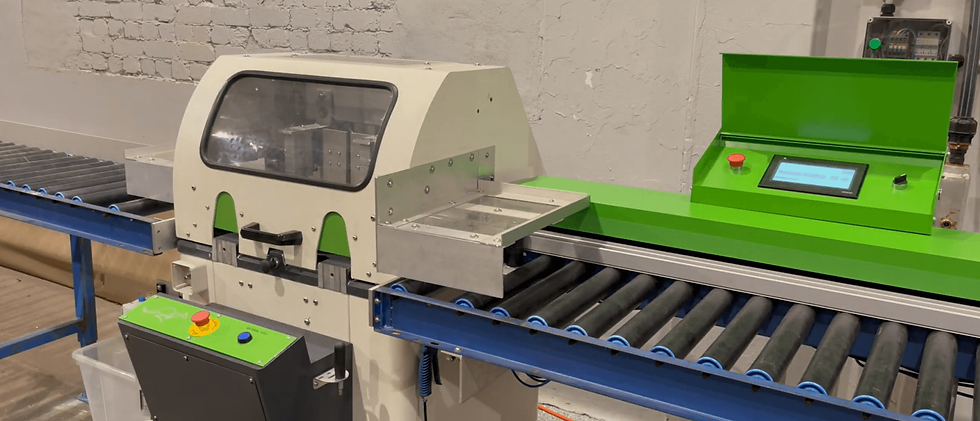
The Kangastop Tradesman is our entry-level digital length stop, and it is designed for maximum reliability. It features a custom extruded aluminium housing that protects the steel-reinforced drive belts, and it uses an industrial-grade Omron PLC (Programmable Logic Controller) alongside a dust-resistant HMI (Human-Machine Interface) touchscreen. It achieves a repeatable accuracy of ±0.1 millimetre, and it runs on a standard 240 V, 10 amp supply.
At a starting price of $5,990, this system provides a rapid payback period of under 12 months for small businesses.
Ideal applications in timber and cabinetry workshops
Bump stops are highly effective in environments where materials are relatively light and cutting sequences are straightforward. Timber and cabinetry workshops use these systems to process standard lengths of wood quickly. Because the operator still handles the material, it is easy to inspect the timber for knots or defects during the feed process.
Push Stops Explained: Advancing to Automated Precision
A push stop takes automation a step further by taking over the physical feeding of the material. This allows the operator to focus on managing the machine rather than pushing heavy lengths of raw material all day.
The mechanics of a push stop system
The operation sequence of a push stop removes manual handling from the cutting cycle. The operator sets the material on the conveyor, and the end is trimmed. They enter the lengths and quantities they wish to cut on the screen, and the push stop automatically pushes the material to the correct length. The saw is then ready to cut, and the machine automatically feeds the material forward for the next cut.
Kangastop Plus: Features and capabilities
The Kangastop Plus functions as a highly capable push stop, and it features an upgraded motor that can process heavy sections up to 50 kg in weight. It includes an integrated software system, and operators can use this to enter raw material lengths and produce an automated cut list. By using this integrated optimisation program, manufacturers are consistently achieving a 12–15% reduction in raw material wastage.
Benefits for high-volume manufacturing like windows and trusses
High-volume operations like aluminium window fabrication and timber truss manufacturing require constant, repetitive cutting. A push stop eliminates operator fatigue, and it drastically speeds up the factory floor. By automating the measuring and the feeding, businesses are reclaiming 4 hours of an operator's 8-hour day because the machine handles the measuring and cutting.
Bump Stop vs Push Stop: A Side-by-Side Comparison
Comparing these two CNC crosscut saw technologies comes down to weighing the initial investment against the operational time saved. Both provide a massive improvement over manual fences, but they serve different production levels.
Comparison table: Tradesman vs Plus
Feature | Kangastop Tradesman (Bump Stop) | Kangastop Plus (Push Stop) |
Primary Operation | Operator pushes material to the stop | Machine pushes material through the saw |
Maximum Material Weight | Standard extrusions and timber | Up to 50 kg sections |
Material Optimisation | Manual calculation | Integrated optimisation program |
Cutting Time Reduction | Over 50% | Maximum efficiency, autonomous feeding |
Accuracy and repeatability differences
When it comes to accuracy, both the bump stop and the push stop deliver the exact same standard. Because both machines use the same high-quality servo-driven encoders and fixed-pitch belts, they both achieve a repeatable accuracy of ±0.1 millimetre. The primary difference is simply how the material arrives at the saw blade.
Ease of use and setup time
Both systems are very simple to learn. The Kangastop Tradesman requires the operator to enter a single measurement into the HMI touchscreen, and the stop moves instantly. The Kangastop Plus requires slightly more input initially to set up a cutting sequence, but it then runs autonomously. We also offer a remote order entry program via USB, and this allows your purchasing department to load cut lists directly into the machine.
Why Australian Manufacturers Choose Kangastop Automated Saw Solutions
Our systems were developed out of necessity because we were horrified by the exorbitant prices charged by European and US suppliers. We focus on providing highly practical machinery that delivers exactly what it promises without the aggressive sales jargon.
Local expertise and support
We manufacture our machines in Australia, and this provides a significant practical advantage for your operations. Local manufacturing ensures ready access to spare parts and local support without waiting on overseas shipping. This local presence allows us to confidently offer an industry-leading 10-year warranty covering both parts and labour.
Safety enhancements in workshop environments
Automated systems naturally improve safety by standardising the cutting process. On our push stop models, we offer horizontal and vertical clamping systems, and these can be controlled directly via the HMI. By using an automated rip fence and remote clamping, the saw operator can keep their hands well away from the danger zone during the cut.
Getting started: Which system suits your operation?
If you are cutting standard lengths occasionally, the Tradesman bump stop is ideal. If you are processing large volumes daily, the Plus push stop is the better investment. We highly advocate for "turn key" and integrated solutions where we supply both the measuring device and the saw. We take responsibility for both the saw and the measuring system so you only have to make one phone call if you need support.
If you would like to see these machines in action, I invite you to visit our factory, arrange a Zoom demonstration, or simply give us a direct phone call to discuss your specific workshop needs.
Frequently Asked Questions About Automated Saw Stops
What is the payback period for an automated saw stop system?
Because the entry-level Kangastop Tradesman starts at $5,990, it provides a rapid payback period of under 12 months for small businesses. This is achieved through direct labour savings and a massive reduction in operator miscuts.
Will a push stop reduce my raw material waste?
Yes. By upgrading to a push stop like the Kangastop Plus, manufacturers are achieving a 12–15% reduction in raw material wastage using the integrated optimisation program.
Do I need to buy a new saw to use a bump stop?
No, our bump stops and push stops can be retrofitted to your existing drop saws, drill presses, or punches using our steel conveyor mounting kits. However, we do offer fully integrated turn-key solutions if you require a complete new setup.


Comments